2019 RESULT L-NP 48 ALP 36 Green 3 SFF 3 IND 3
GOING INTO ELECTION (Occupied/Notional) L-NP 46 ALP 37 Green 3 IND 7
ELECTORAL, POLLING AND POLITICAL ANALYSIS, COMMENT AND NEWS FROM THE PEOPLE'S REPUBLIC OF CLARK. LOOKS LIKE 2026 IS THE YEAR VICTORIA IS FINALLY FREED OF THE CURSE OF GROUP TICKET VOTING! IF USING THIS SITE ON MOBILE YOU CAN SCROLL DOWN AND CLICK "VIEW WEB VERSION" TO SEE THE SIDEBAR FULL OF GOODIES.
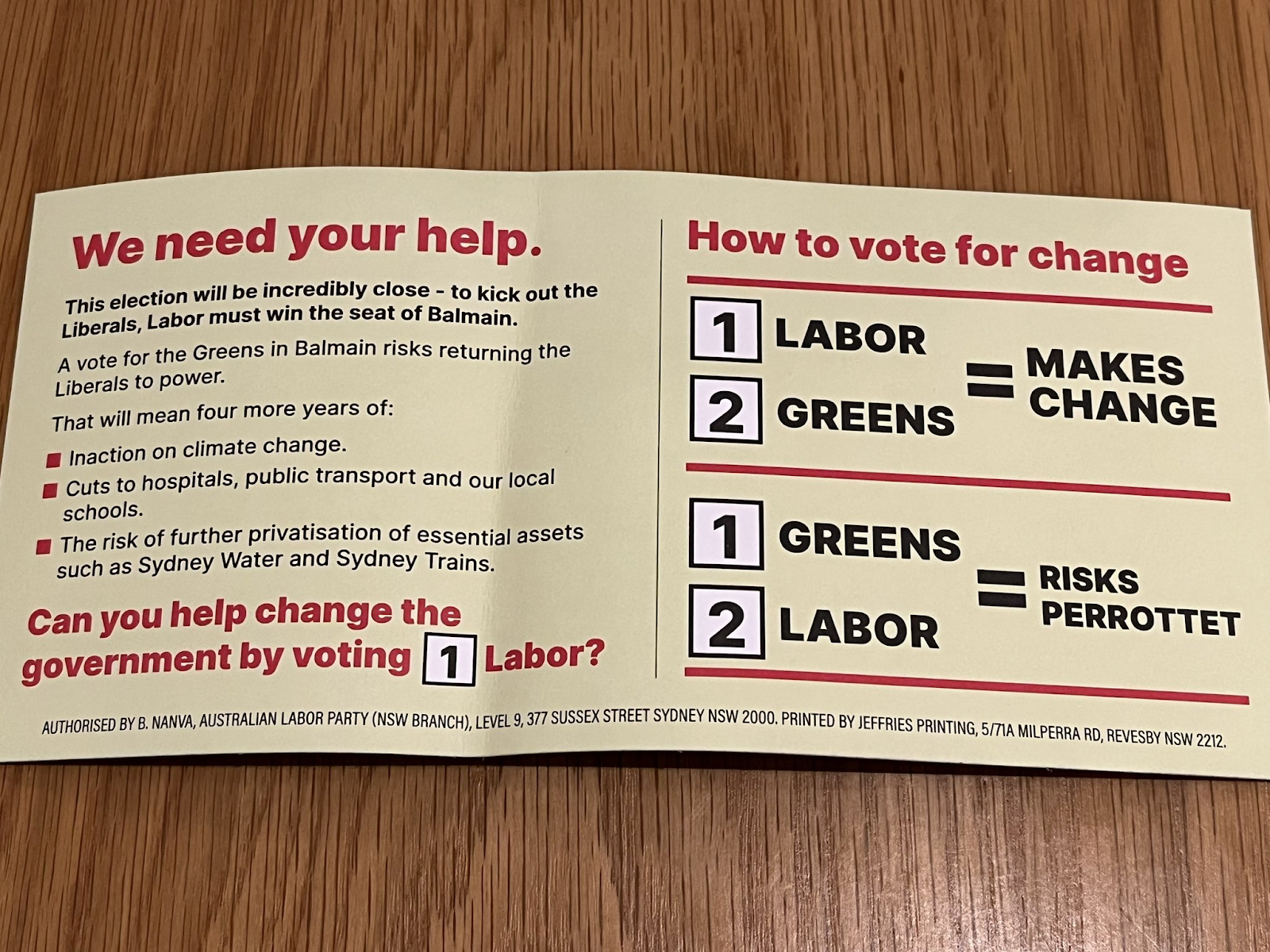
| A Labor flier from Balmain (source) |
The district of Balmain (Green 10.0% vs ALP) would normally be of little interest at this NSW election given that it is on a large margin and the Greens have so far never lost a single seat electorate that they won at a previous general election. What makes Labor think Balmain is worth taking a tilt at is the retirement of 12-year incumbent Jamie Parker, the first Green at state or federal level to retire from a single-seat electorate.
One of the reasons the Greens have 14 wins from 14 attempts at defending state or federal single-member seats won at a general election (by-elections and multi-member seats are different stories) is that there tend to be oversize swings to them in subsequent elections. For a first defence at state and federal levels the average swing is 2.9% on primary vote and 4.0% on two candidate preferred. For a second and later defences it is 3.0% and 4.8% per election. (The 2CP figures are affected in varying directions by Liberal preference recommendation changes, and a 2CP swing is not always available). The obvious explanation for this is demographics, but another possible explanation is that sitting Greens may receive unusually high personal votes. And if they receive them when they defend their seats, maybe they also lose them when they retire?
The release of today's ballot order is a good time for a quick post about the NSW Legislative Council contest for 2023.
NSW uses a single statewide electorate with half-in half-out (21 seats) at each election. Voting is overwhelmingly above the line, and preferencing is fully optional. A below the line option is available but requires filling at least 15 boxes. Voters for parties that don't have an above the line box, or for ungrouped candidates, need to vote this way. See my voter advice section for advice on effective voting below.
The quota for election is 1/22nd or about 4.545%. The major tickets (Liberal/National and Labor) always win several seats each on filled quotas, the more successful minor parties win a few this way, and there is then a race involving the next candidates in line for the parties that have won full quotas and the lead candidates for parties that have polled less than a quota. This race typically fills about the final four seats, and the preferences of excluded parties have some impact here and can help some parties to jump over others if their contests are very close. A party that has well over half a quota on primaries in these races typically wins, those that have well under half a quota lose, and the grey zone is around 0.4-0.6 quotas (1.8-2.7%) - however it varies a little from election to election.
EMRS: Liberal 42 Labor 30 (+1) Greens 13 (-1) IND 13 (-2) (likely to be inflated) Others 3 (+2)
Seat estimate if election "held now" Lib 16-17 ALP 11-2 Green 4-5 IND 2-4
An EMRS quarterly poll of Tasmanian state voting intention taken Feb 14-19 has just emerged, together with an update on the snazzy albeit slightly odd bells and whistles thingy (more on that later).
This poll was taken before this week's resumption of Parliament in which the government has been attacked over two political class scandals. The first involved conflict of interest accusations against the Speaker Mark Shelton concerning very large grants for the upgrade of the Bracknell Hall. Speaker Shelton has used his casting vote to block a referral of the matter to the Privileges Committee, to block a no-confidence motion against him from being brought on, and to block two rather unusual motions that his vote on those motions be disallowed on the grounds of "pecuniary interest". (I have been unable to find any precedent for pecuniary interest provisions being used in this way.) In the second, after one of the parliament's longer exercises in dental extraction there was finally an admission that Racing Minister Madeleine Ogilvie had known the former TasRacing boss Paul Eriksson had been dismissed days before she first misleadingly claimed he had moved to Sydney for family reasons. At times Labor and the Greens were almost tripping over each other trying to work out which scandal to target first.
Today's quick Poll Roundup is provoked by one of the more curious and spurious interpretations by an actual pollster that I've seen. Today's Resolve poll had Labor leading 40-31 on primary votes, which while down on December and January is still the same 9-point lead they held in September and twice in October and off a one point higher primary vote than those. It would come out to a 2PP of around 58-42 to Labor*, which if repeated at an election would result in Labor gaining about 20 seats from the Coalition and winning in one of the biggest landslides ever seen with about 97 seats to the Coalition's 38. Yet Resolve's Jim Reed was quoted as declaring that “It looks like Albanese and Labor’s election honeymoon is over,”. The main justification for this was that Labor had come down slightly from even greater highs in polls taken over the holiday season. The other was movements of a few points from Labor and unsure to the Coalition across a raft of attribute and leadership polling measures, many of which were within the poll's in-theory margin of error and many of which still showed Labor way ahead anyway. (The accompanying article says jobs was one of Labor's biggest setback areas, but on jobs the Coalition's gains came entirely from "someone else" and "undecided").
Yesterday what looks like a quiet electoral year was enlivened just a little by the news that there will be a by-election for the Liberal seat of Aston following the resignation of Alan Tudge, MP since 2010 and Minister between 2016-2022. Tudge was once a minor star of the Coalition government but his rise was tarnished from late 2020 onwards by an extramarital affair with staffer Rachelle Miller, who accused him of harassment and abuse. Tudge denies the accusations, which led to a substantial payout. In recent weeks Tudge has been under the spotlight for his actions surrounding the illegal, disgraceful and barbaric "robodebt" scheme as Social Services Minister in 2016-7. Tudge has cited family and health reasons in his resignation, having flagged his intentions with Opposition Leader Peter Dutton in early January after his father passed away.
This thread will follow the by-election campaign though I will lose interest in it and stop updating the thread if Labor doesn't run and there is no other serious challenger. [Update 17/2 Labor is running and has re-endorsed Mary Doyle.]
Good to be back from the longest posting hiatus in this site's history so far. I have been working on a couple of other pieces during what little time I have had to spare during another round of having months of my life expended by moving house, but I thought I should first make some quick comments about Senator Lidia Thorpe quitting the Greens, largely over differences concerning the proposed Indigenous Voice to Parliament. The Greens support the Voice but Thorpe considers the Voice to be tokenism and supports a treaty first. This week's Newspoll showed that Greens supporters overwhelmingly support the Voice (at least for now) and further highlighted that Thorpe's position is a lonely one within the party.
Thorpe's defection to the crossbench changes the balance of the Senate significantly. Previously Labor and the Greens held 38 seats, meaning their easiest way to pass bills was to obtain the support of David Pocock. The next easiest route involved the two Lambie Network Senators. Now with Labor and the Greens down to 37 they need two votes out of Pocock, Thorpe, Ralph Babet (UAP), the two Lambie Network senators and the two One Nation senators. They also need one of these votes to block motions. While Thorpe will remain a safe vote on climate change related matters, there may be other issues where she is not, especially if she uses her power to horse-trade for her goals. This means the Lambie Network senators may increase their own power since there may be times when it is easier to work with them than Pocock and Thorpe. (Voice-related issues will probably not be those times - Lambie is quite sceptical of the ability of the Voice to deliver change on the ground.)