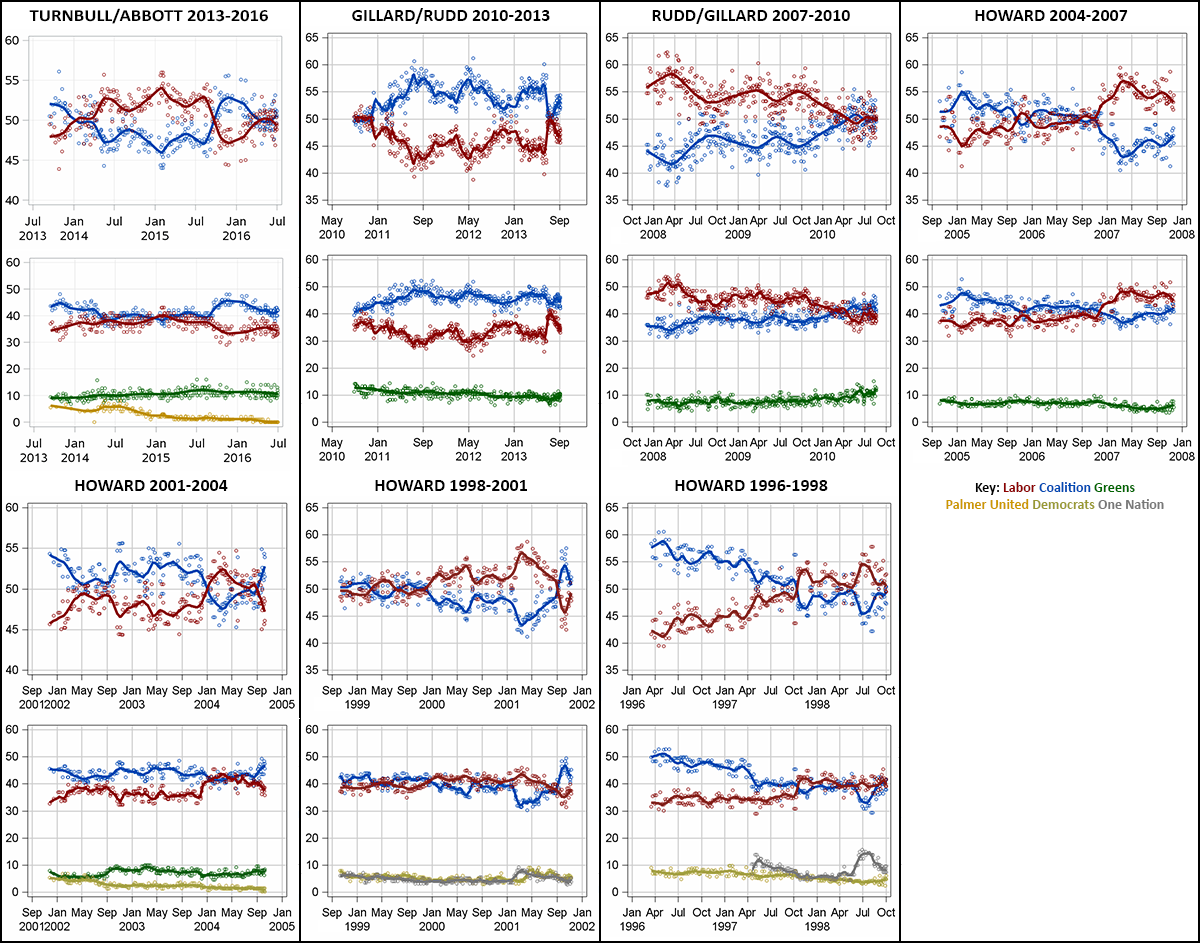
Today, it is 25 years since the Keating Government was turfed by the Liberal-National Coalition led by a second-time Opposition Leader, John Howard. And to mark the 25th anniversary of that occasion too, today I present a polling aggregation for the years 1993-1996. Together with the above Keating piece, this means that 2PP aggregations for all the terms from 1990 onwards are now available online; other historic aggregations are available at Poll Bludger. Incidentally, aggregation itself existed in the early 90s, and while looking for missing poll data I found old newspaper articles by Brian Costar that used 2PP aggregation to estimate election results. What I haven't found yet from that time are any aggregation graphs.
Showing posts with label Downer. Show all posts
Showing posts with label Downer. Show all posts
Tuesday, March 2, 2021
The Howard Aggregation 1993-1996
In 2018, on the 25th anniversary of the Paul Keating's famous and unusual 1993 election victory, I released The Keating Aggregation, an account of the well-known polling downs and lesser-known polling ups of the Hawke-Keating government on its way to that celebrated victory.

Sunday, December 8, 2019
In Search Of Australia's Most Ratioed Political Tweets
Note added Feb 2025: I really enjoyed maintaining this article but stopped updating it early in 2024. At the moment I don't feel inclined to resume it because of dissatisfaction with Elon Musk's undesirable influence on the platform, which has taken the fun out of ratio-spotting for me.
-----------------------------------------------------------------------------------------------------------------
(This article is updated regularly - original introductory text below. To save people the effort of scrolling through to see if a very recent tweet has been added, I will be noting the most recent addition at the top, when I remember that is. The most recent addition was by ABC Insiders added 5 Mar 24)Note new rule added 1 Dec 2020 to address tweets with replies disabled.
Revised new rule added 28 Sep 2023 to address tweets with replies disabled partway and regarding quote-tweet changes to above rule.
RULE CHANGES: Effective 1 Jan 2022 new tweets will need to have a ratio over 10:1 to qualify. They can qualify by either the Replies/Likes method or the Quote Tweet/Retweet method, whichever is higher, subject to at least 100 Replies or Quote Tweets respectively. However I will only track the latter if (i) replies have been disabled or (ii) I have been notified or otherwise become aware that a given tweet is scoring highly on this score. Selected tweets with ratios between 5 and 10 will still be added if they are of unusual interest to me - which includes tweets by the left of politics or relating to opinion polling or elections. )
-------------------------------------------------------------------------------------------------------
Following the 2019 federal election defeat, Labor is having a hard time reappraising its relationship with coal. The party was smacked senseless in mining towns in Queensland and copped a 9.5% swing against it in Hunter (NSW), where Labor voters deserted to One Nation in droves. At the same time, mixed messages on Adani probably saw it lose votes in the other direction to the Greens in the Queensland Senate race. Labor MHR for Hunter, Joel Fitzgibbon, has been particularly keen to reconnect with the coal industry following his own somewhere-near-death experience, but when he tried this on Twitter this week, it mostly did not go down well with the natives:
Following the 2019 federal election defeat, Labor is having a hard time reappraising its relationship with coal. The party was smacked senseless in mining towns in Queensland and copped a 9.5% swing against it in Hunter (NSW), where Labor voters deserted to One Nation in droves. At the same time, mixed messages on Adani probably saw it lose votes in the other direction to the Greens in the Queensland Senate race. Labor MHR for Hunter, Joel Fitzgibbon, has been particularly keen to reconnect with the coal industry following his own somewhere-near-death experience, but when he tried this on Twitter this week, it mostly did not go down well with the natives:

Fitzgibbon's tweet attracted far more replies than likes. On Twitter this (with varying definitions, eg including or not including retweets as well as or instead of likes, where to set the cutoff etc) is known as being ratioed. The formula I use is simply (number of replies)/(number of likes), counting anything over 1 as an instance. While there are cases where tweets attract more replies than likes because they provoke a genuinely long discussion or outpourings of sympathy, these exceptions are very rare indeed (especially in politics). As a general rule, a tweet that is ratioed is so because it has been piled onto by opponents. Frequently there is a very good reason for that, but in politics the response can be affected by partisan bias.
Tuesday, March 12, 2019
Poll Roundup: Medevac Fails To Shift The Dial
2PP Aggregate: 53.4 to Labor (+0.4 since last week)
52.9% with One Nation adjustment
Labor would easily win election "held now" with about 90 seats.
In the wake of the Coalition's 50th consecutive Newspoll 2PP loss, here's another roundup of the state of federal polling, and I also include some comments about the state of seat betting, which I track in the approach to each federal election.
A few weeks back, just after the last roundup, there was a lot of hot air about a possible "Tampa moment" for the Coalition in the form of a close Ipsos poll immediately following the passing of "medevac" legislation by Labor and the crossbench. Since that Ipsos 51-49 (with the Coalition lucky to get 49 on the published primaries anyway) we've seen Newspoll at 53-47 and 54-46, Essential at 52-48 and 53-47 and a commissioned ReachTEL at 53-47. There was also a Queensland-only YouGov-Galaxy with a 6.1% swing to Labor in that state.
52.9% with One Nation adjustment
Labor would easily win election "held now" with about 90 seats.
In the wake of the Coalition's 50th consecutive Newspoll 2PP loss, here's another roundup of the state of federal polling, and I also include some comments about the state of seat betting, which I track in the approach to each federal election.
A few weeks back, just after the last roundup, there was a lot of hot air about a possible "Tampa moment" for the Coalition in the form of a close Ipsos poll immediately following the passing of "medevac" legislation by Labor and the crossbench. Since that Ipsos 51-49 (with the Coalition lucky to get 49 on the published primaries anyway) we've seen Newspoll at 53-47 and 54-46, Essential at 52-48 and 53-47 and a commissioned ReachTEL at 53-47. There was also a Queensland-only YouGov-Galaxy with a 6.1% swing to Labor in that state.
Saturday, June 30, 2018
Worst Opposition Leader Of The Last 45 Years: Round 2
Last month I started a new multi-month Not-A-Poll series to give readers a chance to vote for the Worst Opposition Leader of the Last 45 Years. The groundrules are here. I split the contenders into two groups - those who never or had not yet become Prime Minister, and those who at some stage had been Prime Minister (whether before or after they were Opposition Leader.)
The results of Round 1 are in.
Firstly in Group 1 we now go to a cage match between Mark Latham and Alexander Downer. These two always dominated the voting. At some stages, Brendan Nelson was also above the thresholds for making it into the runoff but he finished up four votes short of the 8% primary vote threshold and nine votes shy of the electability threshold.
The results of Round 1 are in.
Firstly in Group 1 we now go to a cage match between Mark Latham and Alexander Downer. These two always dominated the voting. At some stages, Brendan Nelson was also above the thresholds for making it into the runoff but he finished up four votes short of the 8% primary vote threshold and nine votes shy of the electability threshold.
Subscribe to:
Posts (Atom)