Tuesday, February 22, 2022

Oops!... I Did It Again: Multiple Participation In Opt-In "Polls"

Recently I was involved in a Twitter exchange (of sorts, given the other party's predilection for blocking people they are arguing with) with the founder of a boutique poll-shaped object that I consider to be pretty much complete nonsense.  This "poll" operates by a combination of panel surveying (I wouldn't call it a panel poll as such, since every panel member can respond) and opt-in responses.  

During the (mostly now deleted) tweets in question I have formed the view that the person involved has some unusually serious mental health issues (at least intermittently). Given the way they characterised the experience of being replied to by me and another chap with similar interests, I'd rather soften the impact by not naming them.  However, during the exchange they dared me to vote multiple times in their poll (implying they would detect and remove duplicates), and I said I would do it.  In the interests of science, I publish the details and offer a hypothesis for falsification - if the other party is up to it.  My hypothesis is that I can participate multiple times in this agency's polling and the founder will not be able to catch me.  

Friday, February 11, 2022

New South Wales Feb 12 By-Elections Live And Postcount

Bega (Lib 6.9%) - CALLED 8:48 pm Holland (ALP) gain.
Monaro (Nat 11.6%) - CALLED 8:02 pm Overall (Nat) retain.
Strathfield (ALP 5.0%) - CALLED 10:50 pm Li (ALP) retain.
Willoughby (Lib 21.0%). CALLED following Saturday as James (Lib) pulled ahead on postal votes. 

Thursday, February 10, 2022

Sarah Courtney Resignation And Recount

Bass recount for seat of Sarah Courtney (resigned)
Seat will be won by a Liberal - most likely Lara Alexander or Simon Wood
Alexander had an advantage in votes for which the recount outcome is already known
Alexander has a lead in primaries in the recount and is likely to win. (Update: And has.)

UPDATES FEB 25: The recount has started and I have seen a media report that, unofficially, on primaries Lara Alexander had 44%, Simon Wood 37.6%, Greg Kieser 12.6%, leaving 5.8% for other candidates.  The exclusion process will be relatively fast and Wood will need over 67% of preferences from Kieser and the other candidates, which is unlikely.  Alexander has basically held her lead on known primary votes across the unknown primaries.  

6:20 It's over; Alexander wins by 620 votes (52.9-47.1).  The expected outcome and an unsurprising margin.  Interestingly this is only the second case of a female for female replacement on a recount (after Cassy O'Connor replacing Peg Putt (both Greens.)) The reason turns out to be that only 24 previous female MHAs have completed their careers and of these only four did so by resigning, so there have been very few chances for this to occur.

Monday, January 31, 2022

Poll Roundup: Sea Of Red Polling Ink At Start Of Election Year

After being in a merely historically dicey polling position for much of 2021, the Morrison Government starts this year in more serious trouble.  

Last night's was one of those Newspolls that deserves a quick post because of the dramatic nature of the figures.  The Morrison Government starts the year down 44-56 on primary votes of Coalition 34 Labor 41 Green 11 One Nation 3 Others 11.  Scott Morrison is on a net rating of -19 (38-57), Anthony Albanese is on net zero (by 2022!) (43-43) and Morrison leads on the skewed "Better Prime Minister" indicator by 43-41.

This all represents:

* The Coalition's worst Newspoll 2PP since it polled a pair of 44s in August-September 2018 immediately after Malcolm Turnbull was removed as Prime Minister.

* The Coalition's worst primary vote in the same period, and equal second-worst of all time.

* Labor's best primary vote since December 2018.

* Morrison's worst net satisfaction rating since the early 2020 bushfires, marginally above the -22 he sank to during that time.

* Albanese's best net satisfaction since March 2021.  Albanese is now 19 points ahead on comparative netsat after only taking the lead one poll ago.  

* Morrison's lowest lead on the skewed "Better Prime Minister" question since the bushfire period (in which time Albanese briefly led).

* However, one of the very few cases of a Prime Minister leading on Better PM while this far behind on voting intention.  Not a record in that regard, eg Morrison led by 6 in the second of the 44-56 Newspolls after the removal of Turnbull.

Thursday, January 20, 2022

Poll-Shaped Objects: January 2022

Welcome to a new irregular series for this site.  From time to time I will do a post that covers and comments on all of the poll-shaped objects that come to my attention in a given month.  Where relevant, the article may also discuss real polling on the same issue.  Once I've decided there is enough material and time to put out an issue for a given month, all others that I see in that month will be added to the piece.  However I won't necessarily put out a PSO article every month; usually I will release such articles when there seem to be far too many of the things around and I feel that the proper order of things needs to be restored.  An early version of this idea can be seen in a 2017 article Poll Roundup: Attack Of The Poll-Shaped Objects.

The term poll-shaped object is one that I use to deride the overly credulous reporting of unsound or insufficiently transparent polls in media articles, and also the peddling of such polls by pressure groups, so-called think tanks, parties and other groups that cling to the foolish belief that you can influence public opinion by telling fibs about it.   A PSO can, for instance, be any of (i) something that is claimed to be a poll but isn't (ii) an especially unsound poll or (iii) a possibly sound poll for which the level of reported detail has been woefully lacking.  (The term is by analogy with piano-shaped object, something that appears to be a piano but sounds horrible or is impossible to play - whether by reason of shoddy construction, mistreatment or decay.)

Friday, December 31, 2021

2021 Site Review

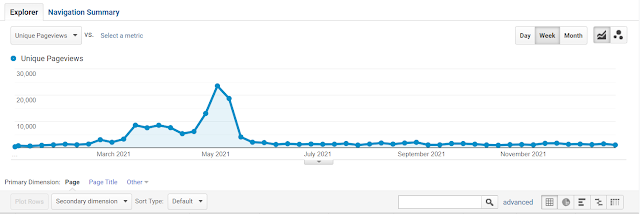
This post presents site data for 2021.  The activity graph tells the story of the year (the units are unique pageviews per week):

Most of the activity in the year came between late February and early June, including the WA election, the Tasmanian state election and the Braddon recount.  The peak for the Tasmanian state election in early May was the fourth most visited week in site history (behind 2016 federal, 2018 Victoria and 2019 federal) and May overall was the fourth most visited month (behind the months of 2016 federal, 2019 federal and 2014 Tasmania/South Australia.)  

Monday, December 27, 2021

2021 Federal Polling Year In Review

 At the end of each year I release a review of federal polling results for the year.  See the 2020 edition here, or click the "annual poll review" tab for articles back to 2014. 

How many polls?

Again the business of counting poll results for 2021 has been complicated by Morgan releasing eight 2PPs as dots on a graph only, and by not yet having anything from Essential since mid-November. (Essential drops its voting intention results in a batch every three months though has said it will be releasing them faster as the election approaches).  

This year saw 16 federal Newspolls released, tying 2020 as the sparsest year since 1991.  Essential has so far released 23, with probably one more to come.  Morgan released 15 as full poll reports, plus another eight that have so far appeared solely as dots on a graph.  New player Resolve Strategic graced us with eight.  That's a total of 62 fully released and eight as 2PPs only, putting us up again to around a level of poll frequency last seen in 2018, but well below the years before.  

Saturday, December 25, 2021

Psephology And The Palace Letters


It's a nearly annual tradition on this site to release something every Christmas Day.  (Click the Xmas tag for previous examples.) It's also an annual tradition when I write the annual review, to list pieces that languished in the draft section, some barely started, others more or less complete but never quite seeing the light of day.  When I did this last year there was an unusual level of interest (a whole three enthusiastic requests!) in one of the unreleased items, about "psephological themes in the Palace Letters" and I decided to make it this year's Christmas present to readers.  This article mostly focuses on the 1974-5 cycle although the letters cover the 1975-7 cycle as well.   By the way, I am not the only psephologist dropping down chimneys with offerings this year.

The Palace Letters are a series of correspondence (not all of it related to federal politics) between the Queen's Private Secretary Sir Martin Charteris and Governor-General Sir John Kerr in the leadup to and the aftermath of the November 11 1975 sacking of the Whitlam Government.  They also include a large number of media articles that are public documents but would not be well known to a modern audience and that are fun to read over.  The letters were released after a very prolonged legal stoush, especially thanks to the persistence of Whitlam biographer and political historian Jenny Hocking.  

Saturday, December 18, 2021

The Overrated Impact Of Party Preferencing Decisions

Advance Summary

1. For all the noise about preferencing strategies and preference flow changes, changes in the relative primary votes for the major parties are a much bigger factor in most recent federal election results.

2. The widespread claim that United Australia preferences caused the Coalition to win the 2019 election is false.

3. Labor is much more dependent on preferences than the Coalition and routinely wins many seats from behind.

4. No party's preferences will ever flow 100% to any other party and there is nothing anyone can do about that - whether it is Greens or Labor being excluded, some preferences will always go to the Coalition.

5. The preferences of climate-concerned independents in city seats tend to flow to Labor, although not quite as strongly as the other way around.

6. In many cases the preference flows from climate-concerned independents are irrelevant, since they will rarely be eliminated in seats that are closely contested between the majors.  

7. How to vote cards mainly exist to protect against informal voting.  Their impact on outcomes is minor.

-------------------------------------------------------------------------------------------------------