Showing posts with label 2022 federal. Show all posts

Friday, February 28, 2025

Tasmanian House of Representatives Seat Guide 2025

  ----------------------------------------------------------------------------------------------------------------------

Donations welcome!

If you find my coverage useful please consider donating to support the large amount of time I spend working on this site.  The sidebar (scroll down and click on "view web version" if viewing via mobile) has Paypal or PayID instructions or email me via the address in my profile for my account details.  Please only donate if you are sure you can afford to do so.
----------------------------------------------------------------------------------------------------------------------

This article gives a detailed discussion of the five Tasmanian House of Representatives seats, which will be updated and edited as needed up til election day.  A Tasmania Senate guide will follow much closer to polling day and will be linked here when up and there will be many other federal pages coming.   I will be doing coverage for The Guardian on election night.

One seat (Lyons, held by Labor) is hotly in play at this election.  Two others (Liberal-held Bass and Braddon) are volatile historically and of some interest though challenging for Labor to win this time around.  Franklin (Labor) is attracting more attention than normal because of a couple of independent attempts.  Clark (Ind) is not considered in play.  

National polling as I start this article has been suggesting the sort of swing to the Coalition that if uniform should see them win Lyons, with Bass out of serious danger and Braddon out of the question for Labor.  However Tasmania has become detached from national patterns in recent years with national swing only predicting Tasmania's two-party seat result perfectly once in the last 33 years (and in recent years Labor tending to do worse in swing terms than the national swing).   Long Labor's strongest state on a 2PP basis, Tasmania ceased to be so in 2022 as demographic transition in low-education and older-voter areas has favoured the Liberal Party.  

Saturday, August 31, 2024

Supporting First Past The Post For Australia Is Pointless

Lately I've been seeing a lot of social media griping about the current government and/or the Greens and teals, mostly from alternative right-wing accounts, in which the writer attacks the Government and says it was only elected because of preferential voting, and we should get rid of preferences by switching to first past the post.   I don't think there is much significant advocacy for first-past-the-post in Australia though Brisbane Lord Mayor Adrian Schrinner has unfortunately supported it (what, optional preferences is not enough for him?), as has Resolve pollster Jim Reed in 2022, and a steady flow of petitions to the Commonwealth Parliament generally with tiny signature numbers.  

The following alone is sufficient reason to dismiss all such calls: First past the post is a discriminatory system that violates the Australian value of a fair go.  Under first past the post, a voter whose most preferred party or candidate is unpopular must make a strategic decision between voting for someone who is not in fact their first preference and effectively throwing away their vote.  However a voter who is pretty sure their most preferred candidate will finish first or second does not have to face that strategic dilemma.  On this basis, having first past the post, in a country able to afford and count a fairer system, is not treating all electors fairly.   I do not think there is actually any valid excuse for keeping single-member first past the post anywhere (though the transition out of it needs to be carefully managed in those places that do have it) but this article is confined to the argument re Australia.  

Australia has a proud tradition of fair voting that started over 100 years ago when preferences were introduced to stop conservative parties from losing conservative electorates when voters were split between two different conservative candidates.  The famous case is the 1918 Swan by-election, but in fact the Hughes Government was working to introduced preferential voting months before it occurred but the legislation had not yet passed the parliament.   When I see supposed patriots with Australian flags in their social media profiles propose that we junk this fine tradition and replace it with unfair and primitive crud voting systems used overseas, I can only shake my head at their claims that they really love this country.   I am not going to let these people get away with it; to paraphrase a slightly different Doctor, this voting system is defended.  

Similar to my polling disinformation register, I've written this article mainly as a labor-saving device so that I don't have to keep making the same long replies on the same points but can simply say "see point 3 here" with a link.  I hope others find it interesting and useful, and more points may be added.

I should note that this article also applies to many criticisms of compulsory preferences made by supporters of optional preferencing - especially part 7.

Saturday, August 3, 2024

"Safe Seats" Falling Is Nothing New

The Australia Institute and its director have been putting out a lot of its usual Hung Parliament Club type stuff about how "power sharing parliaments" are the new normal, how there are no safe seats anymore and so on.  They've been trying to claim that the rise of teals and the decline of major parties means the traditional 2PP swing-based model is more or less dead, although I actually nipped that view in the bud days after the election.  If major party vote shares keep declining we may sooner or later get to a point where 2PP swing-based models cease to be of much use, but 2022 wasn't even close.  See also here, where I point out that the Coalition didn't actually get a raw deal in the "non-classic" seats and what actually caused it to lose so heavily in 2022 was that Labor beat it on 2PP and thumped it on 2PP distribution in the classic Labor vs Coalition seats.

The "power sharing parliaments" analysis misleadingly lumps stable Coalition majority governments and non-majority upper houses in with the sort of thing we saw in 2010.  They're totally different: a true minority parliament involves a government that must make a fresh negotiation for supply and confidence and that continually depends on the crossbench for those things.  (Yes the Coalition has its own internal arrangement but it's a long time since there's been the slightest doubt that the Nationals or their precursors would continue to support a Coalition government).  When there is a "hung Senate" the passing of legislation is often at stake, but except in the most extreme cases supply is not, confidence is not, the composition of the Executive is not.  Hung Senates aren't generally perceived as causing potential stability issues, and the ability of governments to send them to double dissolutions if they keep blocking things can make it easier to browbeat them than it is to browbeat minority Reps crossbenchers.  The most successful governments use Senate obstruction, where it happens, to extend their own lifespans, by being able to signal to their base without having to put up with the consequences of policy their base likes being passed unamended.  A government majority in both houses can easily go to a government's head - cf Howard 2005-7 and Workchoices.

Sunday, July 21, 2024

Effective Vote Spreading: Labor's Hidden Hero At The 2022 Federal Election

This article is about two incorrect narratives about the 2022 election.  I commonly see false claims on social media that Labor only won the 2022 election - not just in majority but at all -because of Green and teal preferences.  These claims are made by certain right-wing posters, mostly of the silly and Trumpy variety, who seek to delegitimise the result because the primary vote winner didn't win the election and the winner's primary vote was unusually low.  But there is another narrative that is more mainstream, which is that while Labor's win was fair enough, the Coalition was hard done by in seat terms because of its seat losses to teal independents.  I show here that that narrative is not really true either, and that the real reason the Coalition's seat share was so bad compared to Labor's was that its vote was poorly distributed in the classic two-party seats.  Most of this article is very numbery so it's been graded Wonk Factor 3/5.

Of course, Greens voter preferences do greatly benefit Labor, and had Green voter preferences split 50-50 Labor would not have won ten seats that it did, and who knows who would have governed in that mess.  But Green preferences favouring Labor is simply part of the scenery, and some other parties' preferences assist the Coalition.  The Coalition only "leads" on primary votes because it is a coalition of two parties that, after decades of fighting each other in some states, choose to mostly work together instead of wasting resources competing everywhere.  Labor and the Greens could sort out their differences and make a similar arrangement if there was any strategic point in doing so, but in their case there currently isn't.  

As concerns teals (whether they won or not), while their 2PP preferences heavily favoured Labor, in most seats where they ran that did not help Labor since Labor failed to make the final two.  This included seven seats that teal independents won, and six where independents who were generally teal-adjacent made the final two but lost.  Yes there were some seats where such candidates were cut out and the contests finished as classic Labor vs Coalition contests, and yes teal preferences helped Labor in those.  But Labor mostly didn't win those anyway (Boothby is one they did win), and there is not a single one where Labor won but would have lost had the teal voters' preferences split 50-50.  In strategic terms the teals were a nuisance to the Coalition, forcing them to fight a second front and making criticisms that may have driven votes to Labor in other seats.  In terms of votes actually polled, however, all they did was take six seats from the Coalition in an election it had already lost outright.  Labor won 72 classic seats where it did not need an edge on their preferences, plus five seats where the Coalition was excluded in lopsided Labor vs Greens contests.

Tuesday, June 25, 2024

"Freedom Parties" Did Not Cost One Nation A WA Senate Seat

Sometimes I find items of interest in the oddest ways.  Today I was searching for tweets about WA Labor (as of 3:45 pm) Senator Fatima Payman in connection with her possible stance on a Greens motion that the Senate consider recognition of Palestine to be a matter of urgency.  I found this tweet by Mark Rowley, to which he links a video in which he tells Pauline Hanson how One Nation was diddled out of a 6th Senate seat by "freedom friendly" micro-parties, hence blaming them for the election of Payman.  

I thought this was an interesting thing to look into.  I find that minor right wing media is often a hotbed for incorrect claims about the electoral system and election results and this case is no different.  

Payman won the 6th Western Australian Senate seat over Filing by a margin of 23490 votes.  Rowley's video singles out three particular micro-parties, the Great Australian Party (led by former One Nation Senator Rod Culleton, who was disqualified from the Senate in 2017), the so-called "Informed Medical Options Party" (IMOP) and the Australian Federation Party.   These parties between them polled 27791 primary votes.  Rowley says that if these parties had voted for "the likes of One Nation" (are there any likes besides One Nation itself?) the party "would have been looking at a 6th Senate position".

Monday, June 17, 2024

Ralph Babet Was Elected Fair And Square. I Know It's Hard But Try To Deal With It

For the avoidance of any doubt at all, I'll start with my view of the subject of this article.  Most of what I see of United Australia Party Senator Ralph Babet is his social media output, and it is awful.  He delivers dumbed-down denser-than-even-Sky-News versions of what were in general stupid ideas to begin with (MAGA nonsense, supposed conspiracies against Christians and western culture, whining about "wokeness", gender, sexuality and multiculturalism, and baiting people who would rather at least try not to get COVID).  Babet is perhaps our purest yet elected example of what happens when you spend way too long inhaling what Christopher Hitchens called "the exhaust fumes of democracy", and then attempt to breathe them out. His Senate career so far has been even cringier than very early Jacqui Lambie.  As with Bob Katter, the concussed-sounding nuttiness of Babet's output frequently leads to debates about whether he's just harmlessly insane or whether some of what he's saying might dangerously affect a few impressionable chaps out there.  Think you can tell I'm not a fan.  

Sunday, April 14, 2024

Every Child Wins A Prize: Federal Seats With Swings To All Contestants

During last night's Cook by-election count there were a few comments about the swing column.  All six parties/independents had recorded a positive swing from the 2022 election.  In the case of Cook this was not at all surprising - three of the parties and the one independent had not even run in the seat in 2022, so their "swing" was automatically plus.  The Greens were always going to get a primary vote swing with no Labor candidate and no prominent left/centre independent.  That left the Liberals, and the question was whether they could gain enough primaries from the 34.6% who voted Labor, UAP or One Nation in 2022 to compensate for replacing a former Prime Minister and 17-year incumbent with some dude from outside the electorate.  This they did with 7% to spare and lo and behold there's a neat little line of pluses in the swing column for the recontesting candidates:

(Apologies to AEC, I've pinched the Wikipedia version for clearer display)

This is a common event in by-elections where one major party doesn't contest.  It has happened by my count in 9 of 21 such by-elections in the last 50 years, the others being Perth and Batman 2018, Higgins 2009, Isaacs 2000, Holt 1999, Blaxland 1996, Wentworth 1995, and Menzies 1991.  Perth 2018 achieved this feat despite having 15 candidates, however only three parties were recontesting.  Blaxland 1996 had five recontestants - I should note that I treat an independent as such only if it is the same person running and doing so as an independent both times.  

Friday, December 15, 2023

Party Registration Tracker 2: The Term After The Crackdown

Note added March 31: No more parties can be registered in time for the election so 32 (-6) is the final tally.  

---------------------------------------------------------------------------------------------------

Parties registered for 2022 election: 38

Parties registered since 2022 election: 8 (1 since deregistered, 1 previously deregistered)

Parties deregistered since 2022 election: 14 (1 tactical deregistration, 1 reregistered under new name,  excludes 1 overturned deregistration)

Parties currently registered: 32

Net change for term: -6

Parties applying for registration: 0

Parties being considered for deregistration: 0

------------------------------------------------------------------------------------------------------------


Introduction (December 2023)

In the 2019-2022 term the then Coalition Government introduced two major changes to party registration law. The first was an increase in the registration threshhold from 500 to 1500 members (parliamentary parties excepted).  The second was a ban on parties using words that were contained in the name of an earlier registered party.  I monitored the impacts of these laws in a resource piece called Party Registration Crackdown Tracker.  

I've decided a sequel is warranted because it appears that the 1500 member rule is having ongoing impacts in its second term in operation and that the party list for the expected 2025 election could be smaller than that for 2022, so I think it is worth a similar level of monitoring.  Of the eight parties that climbed Mount 1500 to be newly registered for the 2022 election or shortly afterwards, five are already deregistered and a sixth being considered.  As a result the first half of the expected 2022-25 term has so far seen the largest net decline in parties of any first half of a term.

Wednesday, September 6, 2023

Australian Polling Denial And Disinformation Register

Introduction (Sep 2023)

Following a Newspoll finding the Indigenous Voice to Parliament Yes side trailing by a horrendous if not all that surprising 38-53 this week, the website arguably still known as Twitter has been even more awash with polling denialism than at other stages in the Yes side's slide down the slippery slope.  The number of people recycling and reciting the same unchecked viral false claims has become so large that it is almost impossible to manage a response to them.  Inspired by the AEC's electoral disinformation register, I have decided to start a register of commonly encountered false claims about polling that are spread on social media, mostly from people claiming to be on the left.  A few right-wing claims are included too, but I don't see those so often at the moment.  (I do see a lot of right-wing electoral disinfo, especially the "3 out of 10 voted Labor" preferential-voting denial.)

Friday, February 10, 2023

Aston By-Election 2023

ASTON (VIC, LIB 2.81%)  April 1 by-election
Liberal to be announced vs Mary Doyle (ALP) and others
Cause of by-election: Resignation of Alan Tudge
Outlook: On historical patterns Liberals should retain - but it may not be easy

Yesterday what looks like a quiet electoral year was enlivened just a little by the news that there will be a by-election for the Liberal seat of Aston following the resignation of Alan Tudge, MP since 2010 and Minister between 2016-2022.  Tudge was once a minor star of the Coalition government but his rise was tarnished from late 2020 onwards by an extramarital affair with staffer Rachelle Miller, who accused him of harassment and abuse.  Tudge denies the accusations, which led to a substantial payout.  In recent weeks Tudge has been under the spotlight for his actions surrounding the illegal, disgraceful and barbaric "robodebt" scheme as Social Services Minister in 2016-7.  Tudge has cited family and health reasons in his resignation, having flagged his intentions with Opposition Leader Peter Dutton in early January after his father passed away. 

This thread will follow the by-election campaign though I will lose interest in it and stop updating the thread if Labor doesn't run and there is no other serious challenger.  [Update 17/2 Labor is running and has re-endorsed Mary Doyle.]

Sunday, July 24, 2022

Federal Election 2022: Pollster Performance Review

In 2019 the Australian polling industry had a disaster after decades of reliability - every final poll had the wrong two-party winner, the final polls were bizarrely clustered around the same wrong result, many final polls were individually wrong by more than their claimed margins and the lack of transparency in the industry was such that it was difficult to understand just why it had happened.

Fortunately 2022 has not been a repeat.  The fallout from 2019 saw a great increase in polling transparency, especially via the formation of the Australian Polling Council (though unfortunately not all pollsters have been on board with that) and also more diversity in polling approaches.  No one poll has ended up nailing the remarkable results of this year's election, but collectively, federal polling has bounced back and done well.   This is especially so on two-party-preferred results, where a simple average of the 2PP figures released in the final polls is pretty much a bullseye. The primary vote results were a little less impressive.

Here I discuss polling in several categories.  Overall YouGov (which does Newspoll) made the most useful contributions to forecasting the result, Redbridge's performance in publicly known niche polling during the campaign was very good, and Resolve Strategic's final poll was a useful counterpoint to Newspoll.  The other major polls were so-so on the whole, and many minor pollsters were wildly inaccurate.

Friday, July 22, 2022

2022 House Of Reps Figures Finalised

Yesterday the 2022 House of Representatives figures were added to the archive of election results, making lots of the usual preference flow goodies available. Although all the preference throws had been completed and uploaded in rough form some time ago, the final figures importantly include the two-party preference flows by party and two-candidate preference flows by party per seat.  As well as this piece I will also be putting out a full analysis of polling accuracy, I expect within the next few days.

Some of the ground that I normally cover in this article was already covered in Two Party Swing Decided This Election (Plus Pendulum).  That article showed that Labor won the election on normal two-party swing in classic Labor vs Coalition seat contests, with changes in the seat share for the major parties pretty much exactly matching historic patterns, and that the groundbreaking defeats for the Coalition at the hands of six new teal independents and two Greens were nonetheless a sideshow in terms of explaining how the election was won.  

Wednesday, July 13, 2022

The Spurious Linking Of "One Vote, One Value" With Territory Senator Numbers

After each election comes a new season in which the Joint Standing Committee on Electoral Matters receives submissions and considers proposals for changes to electoral law.  This JSCEM season has special significance because as well as a change of government in the lower house, there has been a serious shift to the left in the Senate.  Any ALP legislation that is supported by the Greens and ACT Senator David Pocock will have the numbers to pass.

There have been several media articles commenting about this, though it is not always clear to what extent the articles are reporting on what Labor wants, and to what extent they are reporting on what other actors would like Labor to do.  A common theme in these articles (here's the latest) is that a proposal for more ACT and NT Senators appears in the context of a discussion of "one vote, one value" (a principle to which Labor's policy platform included a general commitment without any specifics.)  The linkage of the issue to "one vote, one value" is spurious.  From a pure one vote, one value perspective, the proposal looks like an attempt to rig the Senate to favour the left.

Saturday, June 25, 2022

Two-Party Swing Decided This Election (Plus Pendulum)

We're now just over a month out from a remarkable House of Representatives election.  There's been a lot of attention on the seat gains by six teal independents and three Greens, and a lot of claims that the old two-party preferred model for elections is broken.  Not the case.  Labor won this election on classic two-party swing, largely because the Coalition's primary vote crashed and Labor's (modest as it was) didn't.  The teal gains were a major story of the election and are a big headache for the Coalition going forward, but they are not where the election was won and lost.  

There is a fair amount of nonsense from some fringe supporters of the losing side about Labor's low primary vote, with claims that it is wrong that a party not voted for by two-thirds of the country should govern.  The problem is that both sides had very low primary votes (the Coalition's being lower than, for instance, Labor's primary when it lost heavily under Mark Latham in 2004) and somebody has to win.  Labor was the clearly preferred choice between the two major parties, and would have won this election easily under any single-seat system, including optional preferential voting and first past the post, though in the latter case tactical voting would have given it a much higher (but much less sincere) primary vote.  Those complaining about Labor winning a majority off such a low primary vote should embrace proportional representation or shut up.  (I may write a detailed article about this sometime.)  

Wednesday, June 22, 2022

Senate Reform Performance Review And Senate Notes 2022

The results of this year's half-Senate election are all in so it's time to observe how our still relatively new Senate system performed at its second half-Senate test.  For previous assessments see 2016 part one, 2016 part two and 2019 (single article).  I have changed the title mainly so I am at liberty to add pointless fluff about candidates who finished last.  On the agenda for this issue are: proportionality, blocked Senates, how dreadful this election would have been under Group Ticket Voting, winning vote shares (with a focus on Babet and Pocock), preferencing impacts, just-voting-1, exhaust, informals, below the lines, How to Vote cards, blank above the line boxes, and a special schadenfreude section at the bottom.

Senate voting was reformed in 2016 to remove the problems caused by preference harvesting under the old Group Ticket Voting system, under which Senators were being elected off very low vote shares as a result of networked preference deals and a system that coerced voters into sending their preferences to parties they did not support.  This was not only discriminatory and wrong, but also a threat to the integrity of the electoral system because of the ease with which minor issues could cause a count to collapse.  A great many alarmist predictions were made by defenders of the (no longer defensible) GTV system, and most of those have been debunked already.  However in 2022 there are two new opportunities to test predictions about the new system.  Firstly it is the first time we have had a Senate composed entirely of half-Senate election results.  Secondly, it is the first time Labor has come to power in the House of Representatives under the new system.  

Tuesday, June 14, 2022

2022 Senate Button Press Thread

This thread will follow the Senate button presses as they occur, with details of the results and timing etc.  As I start this thread the button has been pressed in ACT with Katy Gallagher and David Pocock winning as expected.  The distribution of preferences is expected shortly. 

States will be added to this thread as they reach zero unapportioned votes, which is a sign that the button press is imminent.  Until then any further assessments for states will continue to be posted on the Senate postcount thread.  Based on 2019 I was expecting the button presses to occur around June 21 but some races have been significantly faster this time.

ACT

The button has been pressed and the winners as widely called are 1. Katy Gallagher (ALP) 2. David Pocock (David Pocock), with Zed Seselja (Liberal) defeated.  Detail on the distribution later today.

The distribution is here.  Pocock as expected won very easily, defeating Seselja by 7.76% (22133 votes) having caught up to within 1235 before the final Green exclusion (from around 10000 behind after accounting for support candidate votes).  The exhaust rate was higher than usual for the ACT because of the structure of the count, reaching 1.75%. (4986 votes).

Monday, May 30, 2022

Not-A-Poll Reset 4 For 2022: Morrison Defeated

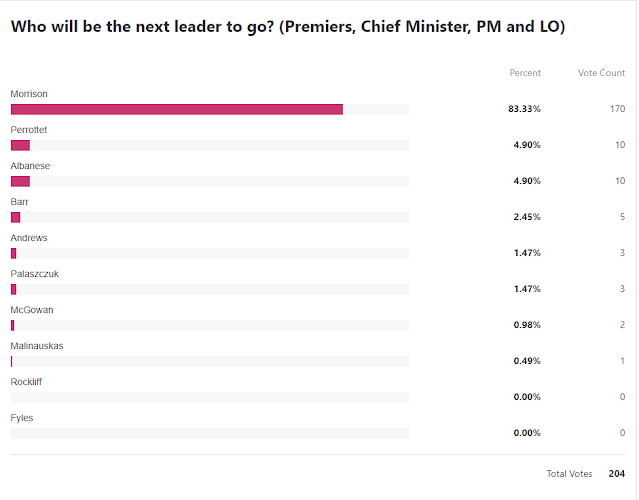
With the announcement that Peter Dutton has been elected unopposed as Opposition Leader, it's time to reset this site's Not-A-Poll for the next leader to depart.  Scott Morrison resigned as Prime Minister after his government was defeated.  The defeat was probably a fairly narrow one in 2PP terms, but in seat share terms it was a disaster, with the Coalition crashing to its worst seat share in the history of the Liberal Party (very slightly worse than 1946 and 1983).  

Morrison's "miracle" win in 2019 gave him a reputation as a great marketer but the 2022 election showed both that this wasn't the case and that he had made himself and his party far less marketable.  Such was the extent of this that even a relatively gaffe-riddled campaign by Anthony Albanese and Labor's difficulties in inspiring primary voting enthusiasm from the left couldn't save him (in part because the gaffes were not about anything that voters cared about).  Morrison joins Andrew Fisher, Joseph Cook, Robert Menzies, Ben Chifley, Paul Keating and Kevin Rudd as leaders who won their first elections as leaders but lost their second. Keating is the most similar since he also took office as PM mid-term through a leadership contest (albeit a more straightforward one) and won an apparently unlikely victory, before being dumped in round two.  Recent PMs who have lost have tended to leave politics soon into their terms; at this stage Morrison intends to stick around but that may not be so welcome in his party.

Anthony Albanese joins Fisher, Cook, Joseph Lyons, Malcolm Fraser sort-of but technically not, Bob Hawke and Rudd as winners from Opposition at their first election as party leader.  But Albanese is the first of these to have served a whole term as Opposition Leader before winning - all the rest took over the job at some stage during the term.

These are the results of the recent (very brief) voting round.


Unsurprisingly Morrison was the crowd tip as the next leader to go, after four cases in which he was heavily backed but not the first to go.  Given that Peter Dutton is likely to last a while in the absence of an obvious rival (unless things go badly enough for Labor for even Morrison to be viable again), it will be interesting to see who voters in this round tip and whether they will be correct.  Only Daniel Andrews (this November) and Dominic Perrottet (next March) have elections coming up anytime soon.  Andrews no longer has the tailwind of a Liberal federal government, which could make the Victorian election more interesting, while Perrottet is no longer disadvantaged by Canberra factors but is the fourth leader of a government that will be 12 years old.  No one else currently looks at risk of being ousted, so the most likely scenario for other leaders would be retirement. 

Tuesday, May 24, 2022

2022 Senate Postcounts: Main Thread

RESULT:  Labor 15, Coalition 15, Green 6, One Nation 1, JLN 1, Pocock 1, UAP 1 

2019 SENATE CONTINUING: Labor 11, Coalition 17, Green 6, One Nation 1, JLN 1 

NEW SENATE: Labor 26, Coalition 32, Green 12, One Nation 2, JLN 2, Pocock 1

Once unapportioned in a state gets to zero, coverage moves to the button press thread. Totals above are updated as confirmed.

------------------------------------------------------------------------------------------------------------

Welcome to my main thread for postcounts for the Senate.  This page will include a summary and updates for each state/territory but over time depending on how the races go and how much time I have I may break out the more complex and unclear races (which currently appears to be Victoria and South Australia) into their own threads.  Some states will receive much higher detail level than others on account of the competitiveness of races.  Where races appear uncompetitive I won't be posting frequent updates.

Sunday, May 22, 2022

2022 House of Reps Summary Page And Vanilla Postcounts

 ALP WINS WITH MAJORITY (FLOOR MAJORITY UNCONFIRMED)

SEATS APPARENTLY WON LABOR 77 COALITION 58 IND 10 GRN 4 KAP 1 CA 1 

Seats apparently changing (not all completely confirmed):

COALTION TO LABOR: Reid, Robertson, Chisholm, Higgins, Boothby, Pearce, Swan, Hasluck, Tangney, Bennelong
COALITION TO GREENS: Ryan, Brisbane
COALITION TO INDEPENDENTS: Wentworth, Mackellar, North Sydney, Curtin, Goldstein, Kooyong
LABOR TO GREENS: Griffith
LABOR TO INDEPENDENT: Fowler

2022 House of Reps Postcount: Macnamara

Macnamara (Vic, ALP vs Lib 6.3)
(2019 3CP Lib 39.5 ALP 33.2 Green 27.3)

Exclusion order issue: final two undecided with Liberal, Labor and Greens all very close at 3-candidate point.

Labor needs to remain in top three to win

Labor will win the seat - just!

This post will follow the postcount in Macnamara, which under its old name of Melbourne Ports delivered the most exciting postcount of the 2016 election, with a two-way contest between Labor and the Greens to make the final two and the Liberals also a chance to unseat Michael Danby.  Six years later the Liberals have totally cooked their chances in the seat after picking two dud candidates in a row, and Josh Burns has replaced the more controversial Danby and appears popular and to be set for life.  Or is he?